
Free-Thinking in 1950…
English mathematician and computer science pioneer Alan Turing dared to ask the question, “can machines think?” Alan created the Turing Test, also known as the imitation game. The Turing test came a few years after the development of the first digital computers and before the coined term, “artificial intelligence.”
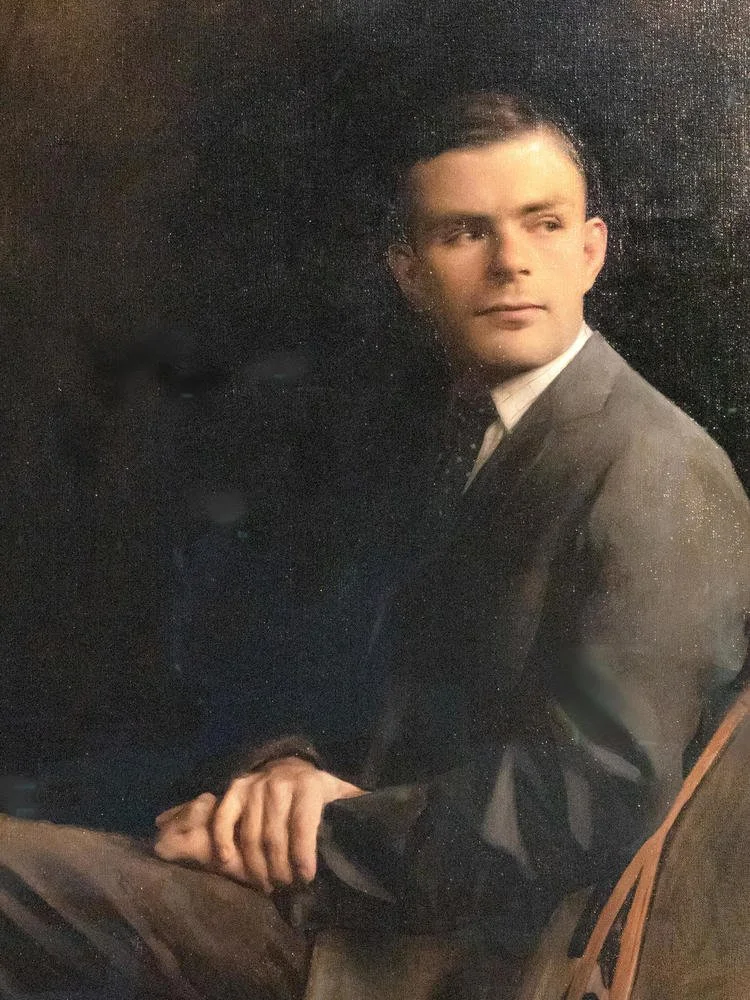
The Turing Test was an adaptation from the Victorian-style game that involved the seclusion of a man and a woman interrogator, who must guess which is which (LLNL, n.d.). In Turing’s version a computer program replaced one of the participants, and the interrogator had to determine who was a person and what was the computer. If the questioner was unable to determine who was human, the computer program would be considered thinking or possess “artificial intelligence.”
Alan Turing’s experiment kickstarted the movement of pushing boundaries and sparking ideas for artificial intelligence. By the mid-1960s AI research in the US was being heavily funded by the Department of Defense.
AI Popularity & Accessibility
Before AI became an instant tool for the general public, it faced many “AI winters.” AI winter is the technical failure and/or temporary decline in market interest. The first AI winter was in the mid 70s and early 80s, but Gurczyński & Mazurek (2026) argue that the first AI winter actually started in the 1960s. There was overpromise and predictions that human level thinking AI was just a few years away. However, algorithms during this time could only solve minute problems. When programs were tasked to solve real-world complex problems, it failed. This lead to technical disappointments due to the lack of optimism that AI can solve and automate complex cognitive activities. The quality of the results of utilizing AI were too low, cost was too high, and the practical advantage over human labor was too weak to justify maintain the existing level of funding (Gurczyński & Mazurek 2026).
The second AI winter started in the late 1980s. AI had many crisis’s such as product, brand, and commercial ecosystem. At first, AI showed promising results in controlled domains; they could support diagnosis’s, device configuration, and solving narrow defined problems (Gurczyński & Mazurek 2026). Unfortunately, limits of the program model was apparent. It’d perform best when the domain was stable and the range of problems were limited. As everything was expanding, so did maintenance costs, conflicts between rules, and difficulty of predicting the behavior of the entire system. It created the “knowledge acquisition bottleneck,” because each update required exorbitant amount money to pay experts and and knowledge engineers. Another growing problem was specialized hardware. To run the programs, they were written in the coding language called Lisp. To functionally operate Lisp, companies like Symbolics and Lisp Machines Inc. manufactured expensive, custom-built workstations called Lisp stations. These expensive workstations had to compete with the up-and-coming general purpose desktop and general workstations. These desktops were not only cheaper, but they were a fraction of the cost of Lisp. The specialized hardware market collapsed overnight because it could not compete with the cheaper and better functioning standard computer.
Starting from 1990s is where there were several improvements to building and using AI such as increased computational power, the proliferation of large datasets, the development of programming libraries, the widespread adoption of GPUs, and the maturation of methods enabling effective training of deep architectures (Gurczyński & Mazurek 2026). Sparks of interest, funding, and adoption surged in the 2010s due to the breakthrough in 2012 when a system loosely based on human visual cortex outperformed every rival in a major image-recognition competition by using large amounts of training data and powerful processors (Carvão, 2025).
Researchers introduced the Transformer model. It was revolutionary because its model design was focused on patterns of attention; essentially teaching AI to decide which words or pieces of information matter most in context (Carvão, 2025). Before the Transformer model, users had to train neural networks with large, labeled datasets that were costly and time-consuming to produce. This became the foundation for the efficient handling and understanding of immerse amounts of text, transforming language-based applications and laying the cornerstone for large language models, also known as LLMs.

Transformers, sometimes called foundation models, are already being used with many data sources for a host of applications (https://blogs.nvidia.com/blog/what-is-a-transformer-model/)
Introducing OpenAI
OpenAI was founded in 2015 as a nonprofit company (OpenAI, n.d.). Their mission is to, “ensure artificial general intelligence benefits all of humanity. This is a multi-faceted endeavor” (Taylor, 2026). To make their mission a reality, OpenAI created a for-profit subsidiary to help scale their research and development efforts in 2019. OpenAI Foundation still exists and currently holds a 26% equity stake in OpenAI Group PBC and retains special voting and governance rights to appoint and remove all members of its board and directors (OpenAI, n.d.). The other stakeholders for OpenAI Group PBC are Microsoft (about 27%) and current and former employees and investors (about 47%).
November 2022, OpenAI publicly launced its LLM, ChatGPT. OpenAI trained the model to interact in a conversational way and make it possible for ChatGPT to answer follow-up questions, admit its mistakes, challenge incorrect premises, and reject inappropriate requests (OpenAI, 2022). The article continues to state they trained ChatGPT using Reinforcement Learning from Human Feedback, also known as RLHF. Within two months of ChatGPT’s launch, over 100 million users were using the program (Mesko, 2023).
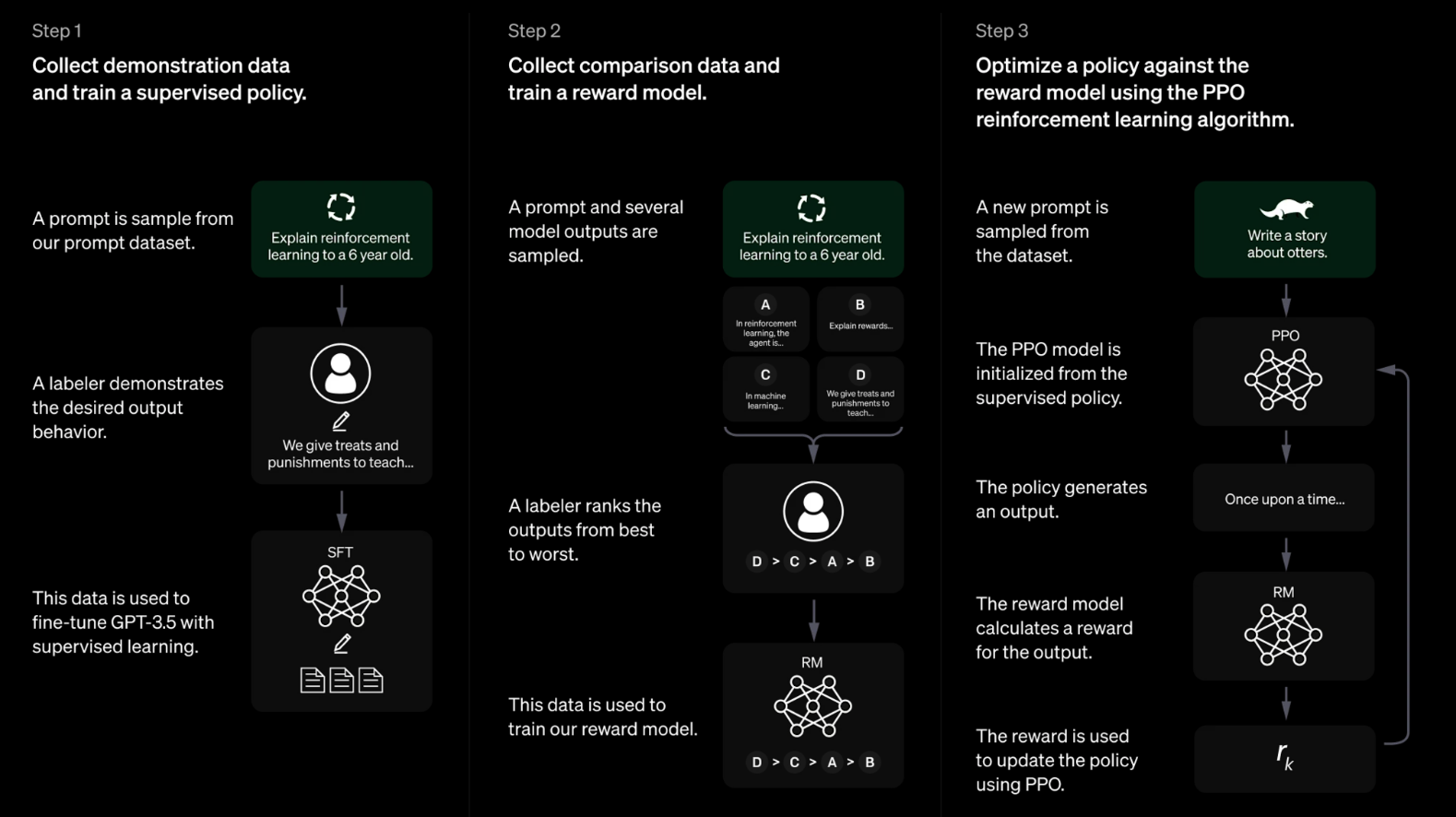
Graphic on OpenAI’s website on how it trained ChatGPT to produce responses that are more helpful and aligned with human preferences, using RLHF.
ChatGPT proved there was a massive consumer market for AI. Major technology companies risked losing customers, revenue, and competitive influence if they did not respond to this success. This had giants such as Google, Microsoft, and Meta to launch their own interactive AI to compete with the successful, and then, unopposed AI chatbot. It even pushed former co-founder of OpenAI, Elon Musk, to launch his own AI chatbot called xAI, now called SpaceXAI, to compete with the ChatGPT.
As AI evolves and is being distributed and consumed more quickly than legal systems, it creates a growing gap of deep uncertainty across global markets. Traditional legal systems move very slowly and lawmakers struggle to understand and keep up with the fast-paced and complex neural networks. Without proactive AI regulation, society faces unprecedented legal voids (Regulating AI, 2026)
Art & Gen AI: Copyright, Consent, & The Legal Gray Area
What rights do artists have when their work is used to train generative AI? Who owns the AI generated work? Are the current laws keeping up?
AI systems depend on massive quantities of data, often gathered by “scraping.” Scraping is the automated extraction of large amounts of data from the internet (Solove & Hartzog, 2025). Scraped data contains people’s personal information. That data can be used for facial recognition, deep fakes, and generative AI, also known as GenAI. There is currently little-to-no regulation with scraping. There is concern regarding the lack of laws and regulation surrounding AI and scraping due to the key principles it violates such as including fairness, individual rights and control, transparency, consent, purpose specification and secondary use restrictions, data minimization, onward transfer, and data requirements (Solove & Hartzog, 2025).
Web scraping is one of the most valuable sources of alternative data for e-commerce businesses due to the massive generating scale of digital information (Cohen & Youssef, 2026). Greene-Sanders (2023), wrote on the Congress website that there are currently no federal laws that ban the scraping of publicly available data from the internet. The issue with scraping is that there is no comprehensive federal AI privacy law.
Greene-Sanders (2023) continues to say,
“Collection of personal information typically implicates certain state privacy laws that provide individuals a ‘right to know’ what a business collects about them, how their data is used and shared, the ‘right to access and delete’ their data, or the ‘right to opt out’ of data transfers and sales…[we] may consider enacting comprehensive federal privacy legislation that specifically addresses generative AI and related concerns.”
There are some laws that include exemptions for the collection of public data. When there is no comprehensive federal data privacy law, many people and groups tried to legally counteract GenAI for reasons such as copyright, defamation, and right of publicity and bring more awareness to the lack of privacy security that GenAI and other AI tools mine for (Greene-Sanders 2023).
In January 2025, the United States Copyright Office submitted the Report on Copyright and Artificial Intelligence and wrote in Part 2, that copyright does protect the original expression in a word created by a human author, even if the work also included GenAI material. The US Copyright Office Report goes to further explain that it does not extend to “pure AI-generated material” where there is “insufficient human control over the expressive elements; prompts do not alone provide sufficient control (2025).
GenAI & Words From The Cosplay Community
Thelia Besk, a cosplayer, said on their TikTok page,
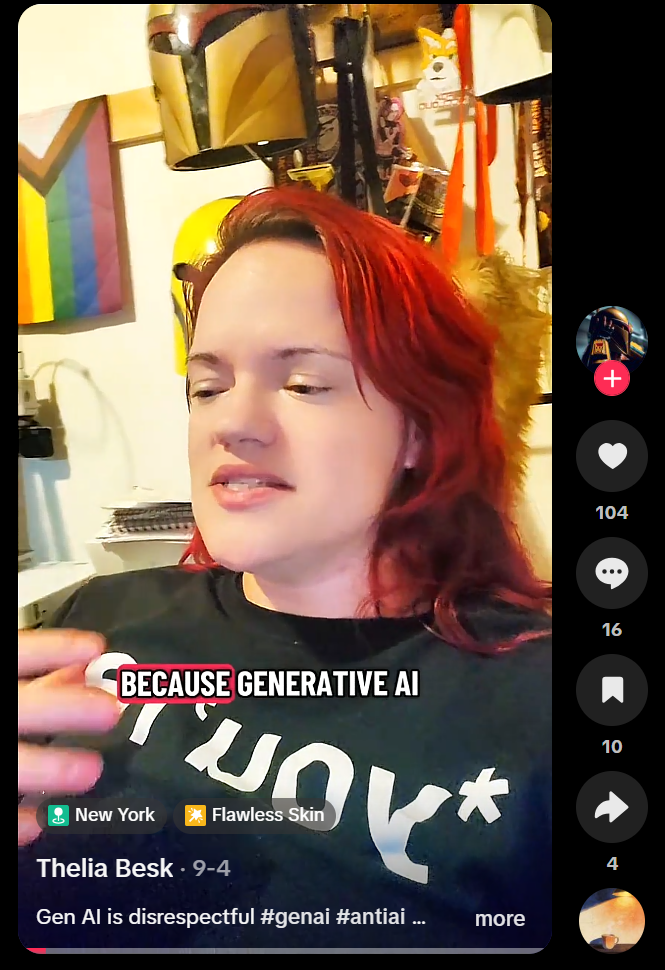
“Every piece of GenAI has to have an original source…it cannot create something from scratch…it’s disrespectful to you, as a human and your innate creativity. AI cannot generate its own creativity.” Besk goes on to say that when someone prompts AI to generate a specific cosplay, the initial cosplayer who posted their work has willingly or unwillingly assisted with generating and completing the prompters request.”
Chillibunny_ on Instagram made a post on October 1, 2025 captioning,
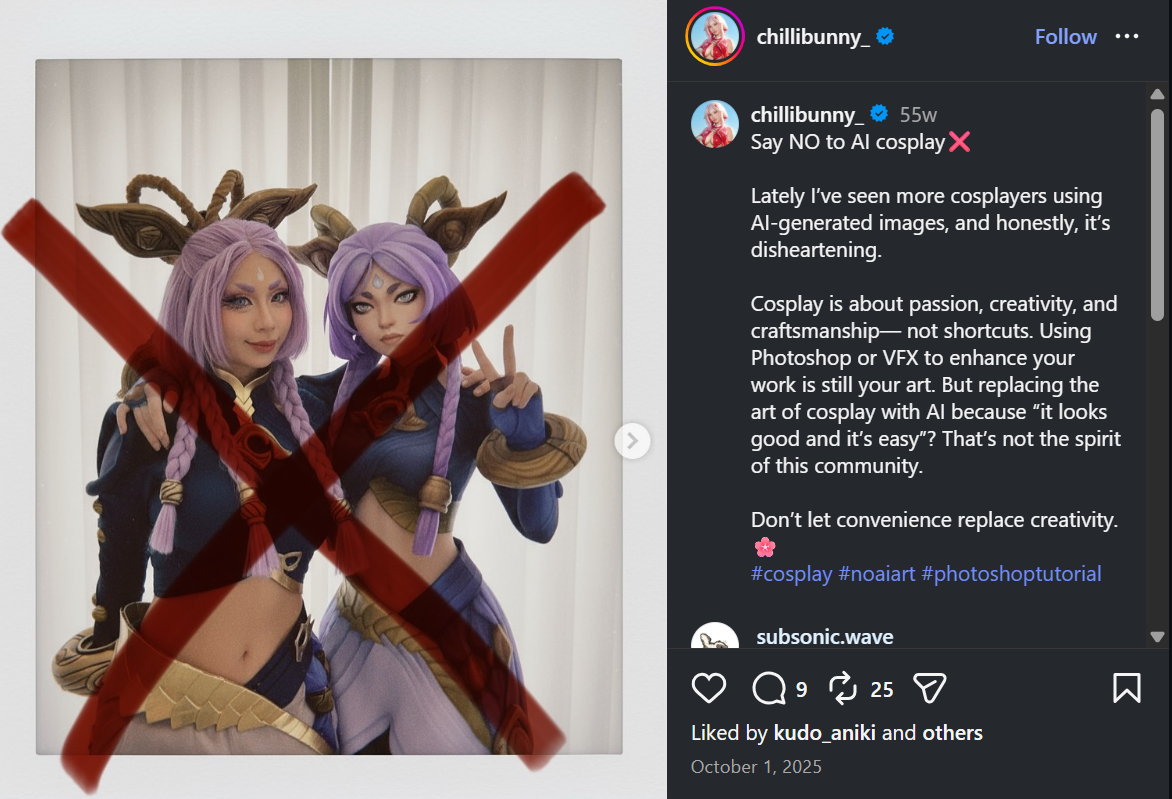
“Say NO to AI cosplay. Lately I’ve seen more cosplayers using AI-generated images, and honestly, it’s disheartening…replacing the art of cosplay with AI because ‘it looks good and it’s easy’...[d]on’t let convenience replace creativity.”
Samurai Jill on Facebook said,
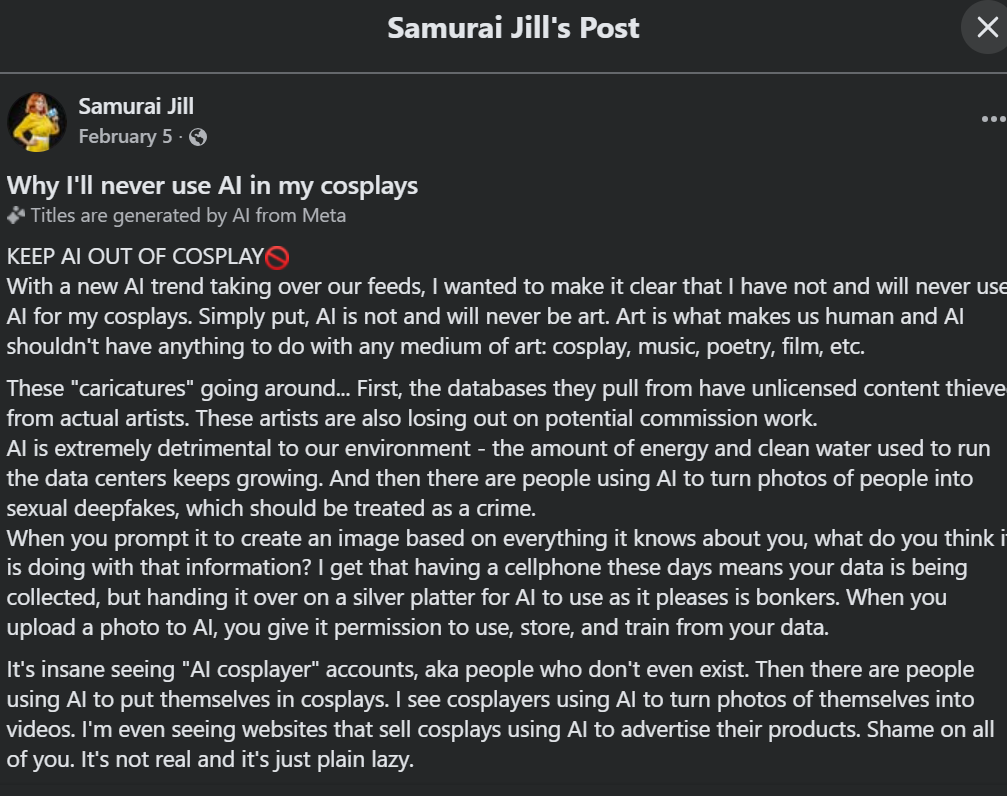
“Ai is not and will never be art. Art is what makes us human and AI shouldn’t have anything to do with any medium of art: cosplay, music, poetry, film, etc…[i]t’s insane seeing ‘AI cosplayer’ accounts, aka people who don’t even exist. Then there are people using AI to put themselves in cosplays…[s]hame on all of you. It’s not real and it’s just plain lazy”
AddyHaraJuku posted a video on their YouTube channel stating that content creators who post their cosplays online, and use GenAI to create the cosplay, do it without disclosing, this leads a false narrative that the creator took the time to create the character rather than just providing a computer system a prompt. Addy goes on to say,
“It really is stolen valor. Not to mention undisclosed AI. It is completely possible to create these detailed wigs, big armor builds, and character accurate makeup yourself…[c]osplay is a hobby for those who love it, [who] often spend a lot of time and money investing in. Learning to start a wig or DIY part of your outfits are just pretty standard skills that you pick up over time as you immerse yourself in the hobby and community. It feels so lazy and counterproductive to remove all the skill from this hands-on hobby.”
Kamuicosplay on Instagram gave her input on photographers using GenAI for cosplay shoot sessions. She states,
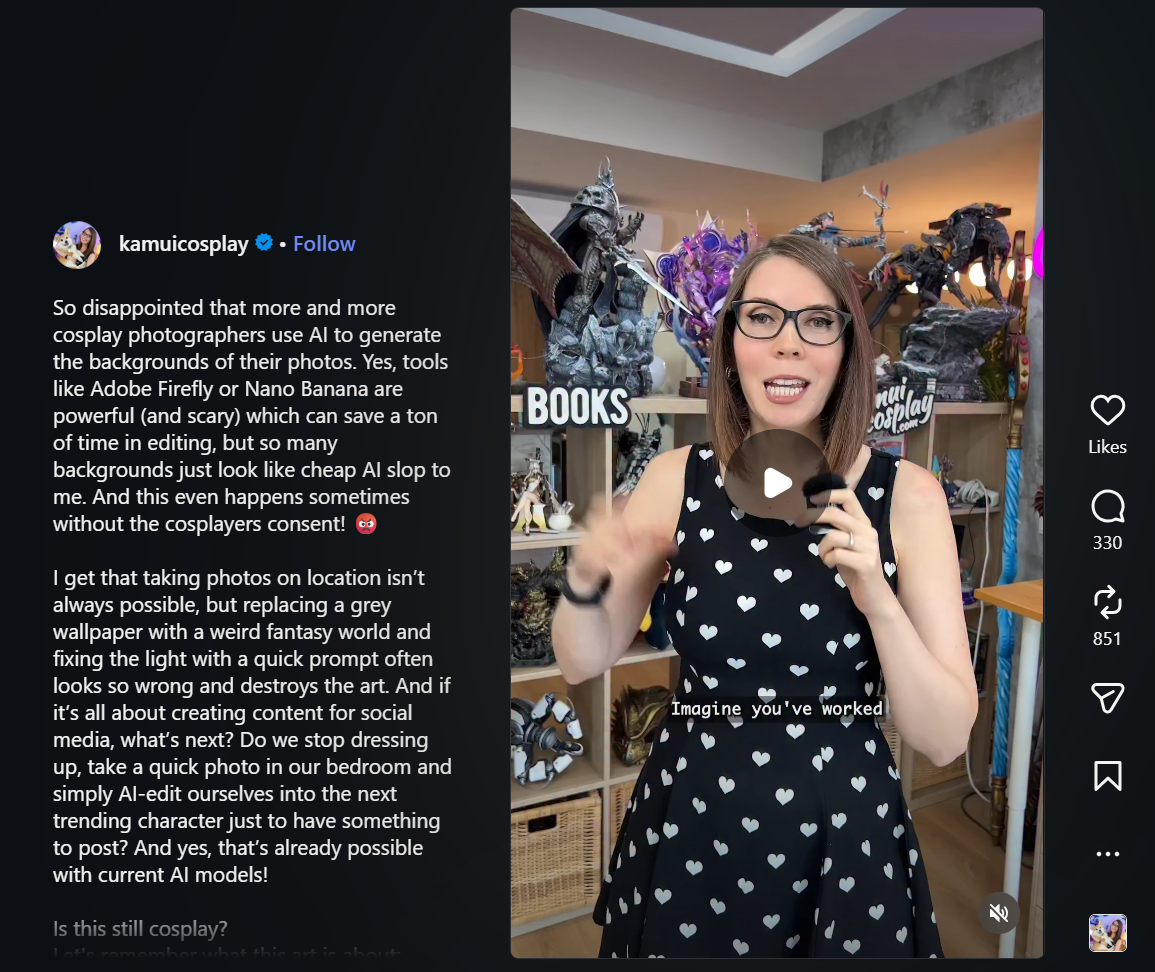
“Sadly, I see more and more cosplay photographers who are using AI generative tools like Adobe Firefly, which can be indeed incredibly powerful. However, it can also lead to lazy photo editing and cheap looking AI slop, and often without even the cosplayers consent. AI generated images have a huge issue within the cosplay community as they come with major moral and environmental issues. [GenAI] devalue the skill of the cosplayer and the photographer…don’t get me wrong, we also use tools [in Photoshop] to let us fill or erase parts of an image and extending a photo can be also very useful…it takes two people to create a stunning image: the model and photographer, and both should be happy with the result.”
Can AI Still Be A Legitimate Creative Tool?
Using AI to rapidly brainstorm silhouettes, color combinations, prop ideas, poses, or rough concepts versus sitting down and sketching ten variations manually. Is that fundamentally different from using Pinterest, Photoshop, 3D software, or other tools to speed up ideation? Where does assistance become a replacement?
Fortino (2025) says that artists have always sought innovative ways to express their ideas, and AI is now enabling them to do just that AI has the potential to enhance your artistic journey in numerous ways such as inspiration and idea generation, visual exploration, music composition, and textural creativity.
AI can analyze vast amounts of data and generate concepts that could inspire an artist (Fortino, 2025). Relying too heavily on GenAI elements can hinder an artists own creative skills; and there is currently a blurred line of what constitutes an artists’ creation and the AI’s contribution.
People who solely rely on AI can regress their exercise ability of cognitive creativity due to the way people obey the law of “use it or lose it.” To help “exercise” your brain is to confront difficult and adaptive challenges, and this goes beyond the cognitive level (Sternberg, 2024). If GenAI does creative work for people all the time, we as creators, risk our creativity because we do not exercise it whether we chose to or not. GenAI is constantly changing, adapting, and expanding. People’s conception of what it means to be creative is also changing; this influences how many people will be creative in society.
If you utilize AI as a tool, it’s important to start with your own ideas before using AI to sharpen concepts or analyze the ideas for possible problems (Djajapranata, 2026). Adam Green, a neuroscientist and professor at Georgetown University researches how AI can hamper with human creativity, but Green’s research has also shows how these emerging technologies can possibly push the boundaries of human creativity.
AI has evolved rapidly and its current position in creative communities remains complicated and divided. Many people who support GenAI use it to create things such as flyers or posters for their businesses or event announcements. While people who oppose GenAI raise concerns regarding safety, copyright, displacement of human artists, and potential loss of originality in creative spaces.
As a business owner in the creative and artwork industry, I use AI for assisting me on the backend of work such as automation, streamlining workflows, and administrative tasks. I draw my boundary of using AI when it comes to generating any art form. I’m not completely anti AI as a technological tool, but I do distinguish it between using it to support my workload and using GenAI to “create” artwork itself.
Cosplaying is an artistic form of expression. It created a community through the shared love of characters, storytelling, and creativity. From designing costumes, crafting props, engineering mechanisms, photography, and editing. Each part of the process reflects the time, effort, creativity, and technical skills of the cosplayers behind it. As GenAI continues to develop, concerns surrounding originality, consent, and the value of human artistry will remain part of the conversation.
Ultimately, there many never be a unanimous agreement where GenAI belongs in art. As these tools become more accessible, it’s imperative to consider what people gain from AI and what people risk losing.
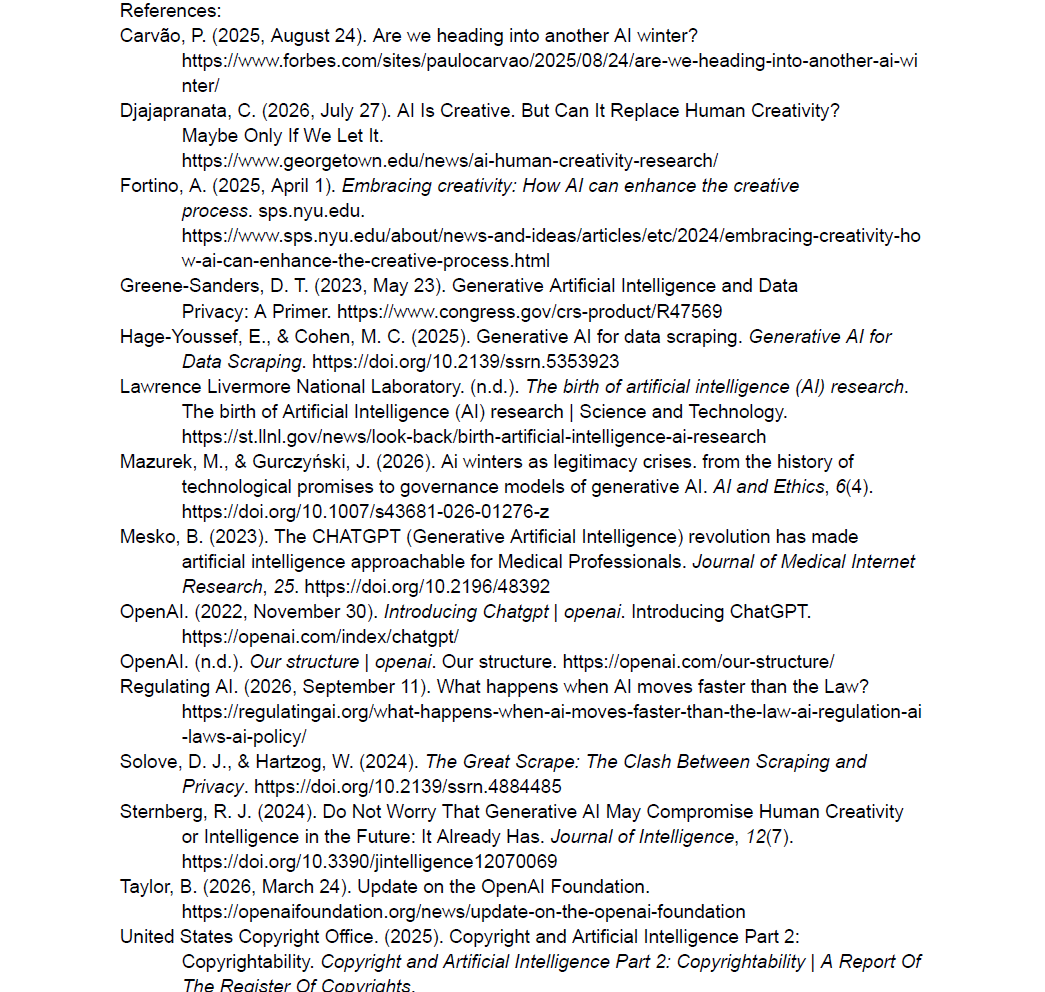
References Used
By: Kira Trinh
